
[:es]
Monumentos históricos y artísticos
 Sus calles y casas
De arquitectura medieval, característica de la región. Su estructura aprovecha al máximo el espacio disponible. Construídas con yeso rojo tradicional, madera, piedra de rodeno y forja.
Caserones de familias nobles
Destaca el palacio de los Monterde de Antillón, en la calle Catedral, el palacio de los Dolz de Espejo, en la calle Azagra y el caserón de los Navarro de Arzuriaga (la casa azul).
 Murallas y portadas
Monumento Nacional desde 1931. El tramo principal, restaurado en los años 80 del siglo XX, data del siglo XIV. Todavía quedan restos de la antigua muralla, del siglo X (la torre del Andador)
Es visitable y desde sus torres se puede disfrutar de una de las mejores panorámicas de Albarracín.
Tanto el portal del Agua como el portal de Molina se encuentran en perfecto estado. El portal de Teruel desapareció en el siglo XVIII.
 Palacio episcopal y Museo Diocesano
El museo diocesano se encuentra en el antiguo palacio Episcopal, del siglo XVIII. Destacan su colección de tapices del siglo XVI, realizados en Bruselas, un portapaz de oro atribuido a Benvenuto Cellini, una cruz parroquial decorada con esmaltes, algunos cálices y un pez de cristal de roca tallada, único en el mundo.
Torre de Doña Blanca
Antigua fortaleza que defendía este sector de la ciudad, está situada junto a la iglesia de Santa María. Inspiró la leyenda de Doña Blanca de Aragón, que pasó en la torre su destierro (según cuentan todavía se la puede ver durante las noches de plenilunio estival, cuando baja hasta el río para bañarse). Ha sido recientemente restaurada y actualmente está destinada a albergar diversas exposiciones artísticas. Gracias a esta restauración, se puede disfrutar de una vista maravillosa, inédita hasta ahora. Es gestionada por la Fundación Santa María de Albarracín.
Junto a la iglesia de Santa María, es el único edificio que queda del Convento de los Dominicos, actualmente convertido en cementerio.
Iglesia de Santiago
Levantada en medio del actual casco urbano de Albarracín. Es obra del arquitecto Alonso del Barrio Dajo, que la inició en 1600, aunque fue terminada en 1626. Templo de una sola nave cubierta con bóveda de crucería estrellada y capillas hornacinas entre los contrafuertes. El altar mayor (1666) es obra de Pedro Castillejo. Se conserva un retablo pintado sobre tablas dedicado a San Roque, San Sebastián y San Fabián (1524), realizado por Jerónimo Martínez. También se conserva el de la Dolorosa, procedente de Molina de Aragón, ciudad muy relacionada con Albarracín.
La tradición popular nos dice que el edificio de enfrente fue la casa de los caballeros de la Orden en Albarracín.
Ermita del Santo Cristo de la Vega
Junto al monasterio, está la ermita del Cristo de la Vega, venerado en Albarracín. En 1559 ya cuidaban este santuario los dominicos. Al terminarse el monasterio de las dominicas en 1621, en 1632 se abordó la actual construcción. En 1703 se añadió la capilla del Cristo en la cabecera de la ermita. Sufrió un incendio en 1872, en el que se perdió la imagen de Cristo que fue sustituida por la actual, obra del escultor valenciano Modesto Pastor.
El Cristo de la Vega en cruz es una de las obras escultóricas de mayor valor artístico de la Sierra de Albarracín.
Casa de la Julianeta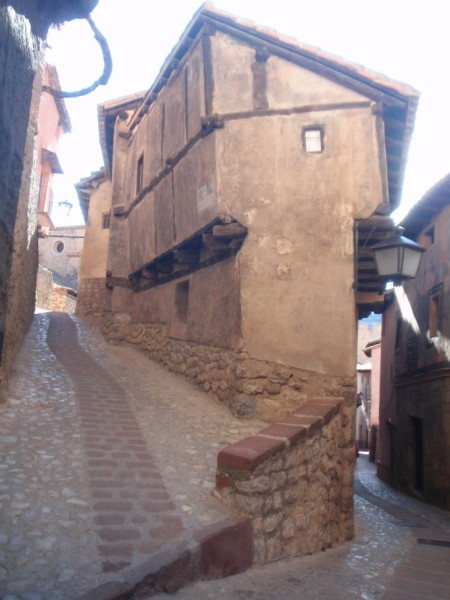
Ubicada en el Portal de Molina. Data del siglo XIV y es el edificio más emblemático de la arquitectura popular de Albarracín.
Construída con yeso y madera, su estructura es sorprendentemente desigual.
Fue restaurada por la Fundación Santa María de Albarracín y actualmente se emplea como taller creativo.
Casa consistorial
Ubicada en la Plaza Mayor, data del siglo XIV y fue reformada en el XVI. Destacan los porches y su balconada del primer piso.
Cuenta con reloj y campana.
Catedral de El Salvador
Construída en el siglo XVI, levantada sobre una iglesia anterior. Su estilo es gótico levantino, con una sola nave y capillas entre los contrafuertes.
De su interior destacan dos retablos: el de la capilla mayor, de Cosme Damián Bas del siglo XVI (una de las obras más importantes del renacimiento aragonés), y el de San Pedro, quizás de Gabriel Joli.
 Iglesia de Santa María
Fue el primer templo del Albarracín cristiano medieval, anterior al año 1200. Puede ser la última obra del maestro francés Quinto Pierres Videl, que no la completó.
Parece que fue terminada por un maestro local, a quien se deben los elementos mudéjares de la parte alta de los muros exteriores. Es el lugar actual de celebración del Ciclo de Música de Albarracín, organizado por la Fundación Santa María de Albarracín.
Castillo de la ciudad
Erigido sobre un peñasco escarpado, por encima del meandro en el que se sitúa la ciudad.
Según un documento de 1581, tuvo en su día tres puertas, de las que sólo se conserva la puerta actual. Su cerco amurallado consta de once torres de planta circular dominante, y un único torreón cuadrado de edad cristiana y aspecto diferente al amurallamiento musulmán. Cierra una superficie de 3.400 m². de gran interés arqueológico, actualmente es gestionado por la Fundación Santa María de Albarracín y es uno de los centros visitables de interés.
Convento de las Dominicas
El Dr. D. Antonio Sánchez Moscardón obtuvo licencia el año 1608 para fundar el Monasterio de San Bruno y San Esteban de las Religiosas Dominicas de Albarracin.
Ermita de Santa Bárbara
Siglo XVIII. Ubicada en el barrio del Arrabal.
[:en]
Historical and artistic sights
Streets and houses
The narrow, sometimes steep streets wind through the old city centre. The houses, built with pink red gypsum, wood and sandstone, tower high above them. The ironworks before the windows are conspicuous.
Houses of noble familiess
Albarracín numbers three houses of noble families from former times. Both their interior and their exterior are abundantly decorated. These houses are: the palace that belonged to Monterde de Antillón family, at the left-hand side in the street that runs from the Plaza Mayor to the cathedral, the palace of the Dolz de Espejo family (nowadays called the hotel Albarracín) and the adjacent house of the Navarro de Arzuriaga family (La Casa Azul – The Blue House)
Murallas and portadas
The city wall and the entrance gates
The city wall has been a national monument since 1931. The biggest part dates from the 14th century and was resored in the 80s of the 20th century. The oldest parts, amongst which the highest tower, la torre del Andador, date back to the 10th century. A visit to the wall is most rewarding: once on top of the wall you have a magnificent view over Albarracín.
In the late Middle Ages, Albarracín had three main entrance gates. The Portal del Agua and the Portal de Molina are still in perfect state. However, nothing has been preserved of the Portal de Teruel, originally located near the current hotel Albarracín.
Episcopal palace /diocesane museum
The diocesane museum is has its seat in the 18th century episcopal palace. Remarkable pieces from the collection are the 16th century Brussels tapestries, a gold pax tablet, attributed to Benvenuto Cellini, a decorated parish cross, several chalices and a fish, carved out of rock crystal.
The Doña Blanca tower
Originally the Doña Blanca tower, next to the Santa María church, was a fortress that protected the southern part of the city. The legend of Doña Blanca of Aragón is based on this tower where this princess spent her days in banishment. According to the legend she still shows herself every summer during full moon when she descends to the river to bath. The tower was restored recently and is used nowadays as exposition space. The rooftop offers a beautiful view over Albarracín.
Together with the Santa María church the Doña Blanca tower is the only part remaining of the Dominican monastery. Originally, the cementery also formed part of this complex.
Santiago church
This church can be found in the midst of the old city centre. The construction started in 1600 under guidance of the architect Alonso del Barrio Dajo and was finished in 1626. The church has got only one nave under a star-shaped ribbed vault and chapels in the niches between the buttresses. The main altar was made by Pedro Castillejo. The consecrated altarpiece from 1524 is dedicated to San Roque, San Sebastián and San Fabián. It was painted on planks by Jerónimo Martínez. Another ancient altarpiece that can be seen is from la Dolorosa. This piece is from Molina de Aragón, a city with close ties to Albarracín.
Tradition has it that the house opposite the church the home of the knights of the Order of Albarracín.
Santo Cristo de la Vega Chapel
The Santo Cristo de la Vega Chapel is next to the Dominican monastery. In 1559 already the Dominicans took care of this sanctuary. In 1632 the construction of the current chapel was started. In 1703 the chaspel of Christ was built on on the kopse xx side. A fire burnt the crucifix in 1872. It was replaced by the current figure of Christ. This statue is one of the works of art with the highest artistic value of the whole Sierra de Albarracín.
Casa de la Julianeta
This house, from the 14th century is near the Portal de Molina. With its capricious forms this house is the most illustrative example of Albarracín´s popular architecture. After being restored
by the Fundación Santa María de Albarracín in the early 21st century, it is now used as a studio.
Town Hall
The town hall is located at the Plaza Mayor. It was built in the 14th century. Its current appearance dates from the 16th century, when it was renovated.
Cathedral El Salvador
The late gothic cathedral was built in the 16th century on the foundations of an older church from the 12th Century. The cathedral has got only one nave and, in between the buttresses, several chapels. Two altarpieces in particular are striking: in the main chapel the one by Cosme Damián Bas from the 16th century (one of the most important pieces from the Aragonese Renaaissance) and the one of Saint Pete. At the end of the 18th century the interior of the cathedral was restored. Baroque elements, like the pilasters, were added.
Santa Maria Church
This church was built before 1200 and therefore was the oldest church of medieval Christian Albarracín. The main architect was the Frenchman Quinto Pierres Videl who was not able to finish it the project. Probably a local architect took over the work. He added several mudéjar elements in the higher parts of the outer walls. Nowadays, the cathedral forms the setting for classical concerts.
The Castle
The castle is built on top of a steep rock, high above the Guadalaviar River.
A document from 1581 shows that at the time the castle had three entrance gates, only one of which still exists. The wall counts eleven round towers and one square tower that was built during the Christian period. The castle, that can be visited, covers an area of about 3,400 m2.
Dominican monastery
In 1608, Antonio Sánchez Moscardón was granted permission to build the monastery of San Bruno and San Esteban of the Order of the Dominicans of Albarracín. The work was finisghed in 1621.
Santa Bárbara Chapel
This 18th century chapel can be found in the neighbourhood “El Arrabal”.
[:nl]
Historische en artistieke monumenten
Straten en huizen
De smalle, soms steile straatjes slingeren zich door het oude stadscentrum. De huizen, opgetrokken uit rozerood gips, hout en zandsteen, torenen er aan weerszijden hoog boven uit. Opvallend zijn de smeedwerken voor de ramen.
Huizen van adellijke families
Albarracín telt drie huizen van adellijke families uit vroeger tijden. Deze huizen zijn rijk versierd, zowel aan de binnenkant als aan de buitenkant. Deze huizen zijn: het paleis van de familie Monterde de Antillón aan de linkerhand in het straatje dat vanaf de Plaza Mayor naar de kathedraal loopt, het paleis van de familie Dolz de Espejo (het huidige hotel Albarracín) en het daarnaast gelegen huis van de familie Navarro de Arzuriaga (La Casa Azul – Het Blauwe Huis).
De stadsmuur en de toegangspoorten
De stadsmuur is een nationaal monument sinds 1931. Het grootste deel dateert uit de 14e eeuw en is gerestaureerd in de jaren 80 van de 20e eeuw. De oudste delen van de muur zijn uit de 10e eeuw, zoals bijvoorbeeld de hoogste toren, la torre del Andador. Een bezoek aan de muur is de moeite waard; bovenop de muur heeft men een schitterend uitzicht over Albarracín.
In de late Middeleeuwen had Albarracín drie toegangspoorten. De Portal del Agua en de Portal de Molina zijn nog steeds in perfecte staat. Van de Portal de Teruel, oorspronkelijk gelegen bij huidige hotel Albarracín is niks meer bewaard gebleven.
Bisschoppelijk paleis/diocesaner museum
Het diocesaner museum is gevestigd in het oude bisschoppelijke paleis uit de 18e eeuw. Opvallende stukken uit de collectie zijn de 16e eeuwse Brusselse wandtapijten, een aan Benvenuto Cellini toegeschreven gouden paxtafel, een versierd parrochiekruis, een aantal miskelken en een uit rotskristal gehouwen vis.
De toren van Doña Blanca
De toren van Doña Blanca, naast de kerk Santa María, was oorspronkelijk een fort dat het zuidelijke deel van de stad beschermde. De legende van Doña Blanca van Aragón is gebaseerd op deze toren waar deze prinses in ballingschap haar dagen sleet. Men zegt dat je haar bij vollemaan in de zomer nog steeds kan zien wanneer ze naar de rivier gaat om zich te baden. De toren is recentelijk gerestaureerd en wordt tegenwoordig gebruikt voor exposities. Hierdoor is het mogelijk geworden om van een schitterend uitzicht te genieten.
Met de kerk Santa María is het het enige bouwwerk dat over is van het Dominicaner klooster, dat oorspronkelijk ook de huidige begraafplaats omvatte.
Jacobskerk
Deze kerk staat midden in de oude stadskern. De bouw begon in 1600 onder leiding van de architect Alonso del Barrio Dajo en werd in 1626 afgerond. De kerk heeft één schip onder een stervormig ribgewelf en kapellen in de nissen tussen de steunberen. Het hoofdaltaar is van Pedro Castillejo. Het aan San Roque, San Sebastián en San Fabián gewijde altaarstuk uit 1524 van Jerónimo Martínez is geschilderd op planken. Ook een altaarstuk van la Dolorosa is bewaard gebleven. Dit stuk is afkomstig uit Molina de Aragón, een stad die hechte banden heeft met Albarracín.
Volgens de overlevering is het huis tegenover de kerk het huis van de ridders van de Orde van Albarracín.
Kapel Santo Cristo de la Vega
De kapel Santo Cristo de la Vega staat direct naast het Dominicaner klooster. Al in 1559 hadden de Dominicanen de zorg over dit heiligdom. In 1632 werd begonnen met de bouw van de huidige kapel. In 1703 werd aan de kopse zijde de Christuskapel aangebouwd. Bij een brand van 1872 ging het Christusbeeld in vlammen op. Het werd vervangen door het huidige beeld. Dit beeld behoort tot de kunstwerken met de grootste artistieke waarden van de gehele Sierra de Albarracín.
Casa de la Julianeta
Dit huis is uit de 14e eeuw. Het staat vlakbij de Portal de Molina. Met zijn grillige vormen is dit huis het sprekendste voorbeeld van de populaire architectuur van Albarracín. Nadat het begin 21e eeuw gerestaureerd werd door de Fundación Santa María de Albarracín is het nu in gebruik als atelier.
Gemeentehuis (Casa consistorial)
Het gemeentehuis ligt aan de kop van de Plaza Mayor. Het is gebouwd in de 14e eeuw en verkreeg met de verbouwingen uit de 16e eeuw haar huidige vorm.
Kathedraal (Catedral de El Salvador)
De laat-Gotische kathedraal is in de 16e eeuw gebouwd op de fundamenten van een oudere kerk uit de 12e eeuw. De kathedraal heeft slechts één schip en tussen de steunberen verschillende kapelletjes. Met name twee altaarstukken zijn opvallend: in de hoofdkapel het altaarstuk van Cosme Damián Bas uit de 16e eeuw (een van de belangrijkste stukken uit de Aragonese Renaissance), en die van Sint Petrus. Aan het eind van de 18e eeuw is de kathedraal aan de binnenkant gerestaureerd. Er zijn toen barokke elementen toegevoegd, zoals de pilasters.
Santa Maria Kerk
Deze kerk is gebouwd vóór 1200 en daarmee was dit de oudste kerk van het middeleeuwse christelijke Albarracín. De hoofdarchitect was de Fransman Quinto Pierres Videl die het echter niet heeft kunnen voltooien. Waarschijnljk is het afgemaakt door een lokale architect die verschillende mudéjar-elementen heeft aangebracht in de hogere delen van de buitenmuren.
Tegenwoordig worden in de kathedraal klassieke concerten georganiseerd.
Het kasteel
Het kasteel is gebouwd bovenop een steile rots, hoog boven de rivier Guadalaviar.
Uit een document uit 1581 blijkt dat het kasteel destijds drie poorten had waarvan er tegenwoordig nog één over is. De ommuring bestaat uit elf ronde torens en één vierkante toren die uit de christelijke tijd stamt. De ommuurde oppervlakte van het kasteel, dat te bezichtigen is, is 3.400 m².
Dominicaner klooster
In 1608 verkreeg Antonio Sánchez Moscardón vergunning om het klooster van San Bruno en San Esteban van de Orde der Dominicanen van Albarracín te bouwen. In 1621 was het klooster gereed.
Kapel van Santa Barbara
Deze 18e eeuwse kapel staat in de wijk El Arrabal.
[:]